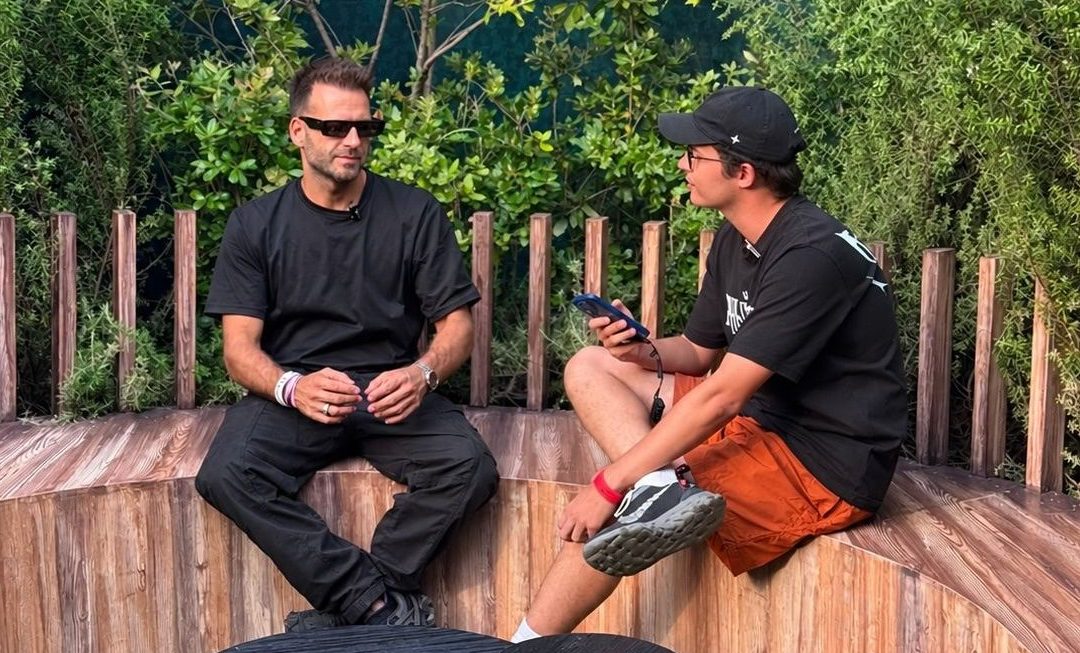
In an electronic music landscape that is constantly evolving, Enrico Sangiuliano continues to stand out for a quality that has become increasingly rare: consistency. Every set is the result of meticulous research, every production adds another piece to an artistic journey built without compromise. He proved it once again at Tomorrowland Belgium 2026 (read our recap), where he delivered one of the strongest techno performances of the second weekend on the iconic Freedom Stage.
Shortly after stepping off stage, we sat down with Enrico to discuss his current artistic vision, the philosophy behind his projects, and how he sees the future of electronic music unfolding.
yB: Hi Enrico, thanks for taking the time to speak with us. You’ve just come off the Freedom Stage, one of Tomorrowland’s most immersive and technologically advanced stages—a huge warehouse-like environment. Your last appearance at the festival was back in 2023 at the Atmosphere Stage. How did this performance feel, and how do you see Tomorrowland evolving, both in terms of its audience and its technological development?
Enrico: The Freedom Stage immediately appealed to me because it really feels like a club. In a club you have much more space to take people on your own journey. Even within a festival where there are so many different stages, being inside a compact environment like that can be incredibly rewarding, and that’s exactly what happened today.
I noticed the stage was packed from beginning to end, without much turnover in the crowd. It genuinely felt like my audience stayed there for the entire set. That’s much more of a club dynamic than a festival one, and seeing that inside Tomorrowland was extremely satisfying. At festivals you often see a more casual crowd moving from stage to stage, sometimes leaving as soon as you play something less familiar. Today wasn’t like that. From a DJ and performance perspective, it was a huge satisfaction.
yB: While I was listening to your set, one thing that really caught my attention was the visuals. Were they specifically created for today’s performance, or were they adapted from previous projects?
Enrico: No, they didn’t exist before today. They were developed specifically after researching what could be achieved on this particular stage. I hadn’t submitted any playlist beforehand—I honestly didn’t know what I was going to play until the very last second. So, what happened today was both a VJ performance and a DJ performance working together in real time.
yB: This summer you’ve introduced several new concepts and performance formats. We saw Journey of Sound at Milan’s Triennale this spring, then again at Kappa FuturFestival a few weeks ago. At Kappa you also presented your Archivio set.
Can you tell us about the ideas behind these projects? And do you see yourself developing them further over the coming months or years?
Enrico: The idea behind Journey of Sound is to perform in a space that allows both time and attention. By attention I mean giving people the opportunity to truly listen—to focus on the details and immerse themselves in what a DJ can create beyond simply playing records, almost like shaping a sonic landscape. At the Triennale we had an incredible sound system that had been specifically designed for that room, so I was able to express an extraordinary level of detail. It felt almost like being in a cinema.
We then brought that concept to Kappa FuturFestival, opening the Main Stage with an experience that was completely different from a traditional opening set. It started with ambient and beatless music before gradually moving into 80 and then 100 BPM. It became a journey. It was Sunday, so in a way it felt like a reset—a chance to begin the festival’s final day with a different mindset. It was also my third set in three days, and I wanted to encourage people to embrace music they probably wouldn’t expect to hear at a festival.
Archivio, on the other hand, was a deep research project into the records that helped shape our dance music culture—techno, progressive, trance… back then we didn’t even really think in terms of genres. It was all part of what we’d simply call club culture, especially in Italy during the ’90s. That was the first of the three sets I played while closing the Cosmo Stage. I’d never seen that stage so full. It was incredible. I expected it to be something special because those records mean so much to me personally, but I never imagined the audience would react the way they did. The place was absolutely packed, the energy was amazing, and I could see people who had actually lived through that era looking around in disbelief at what they were hearing.
At the same time, I could see younger generations discovering this music for the first time—recognizing sounds that still feel contemporary in some cases, nostalgic in others, all blended together into something hypnotic and driving. It was a beautiful experience. Both Journey of Sound and Archivio definitely have the potential to continue evolving in the future.
yB: I wanted to go back to an interview you gave around eight years ago, where you spoke about how you first became passionate about music and how you started studying sound design. A lot has changed since then—including a global pandemic—and the electronic music scene is very different today.
What advice would you give to a young person who’s discovering electronic music and wants to start producing and developing their own sound?
Enrico: My biggest piece of advice is simple: have fun. That’s the most important thing. Let yourself be guided by your natural curiosity and attraction towards music. That’s how a genuine passion is born. Once that passion is real, you don’t need to chase anything.
You don’t need to obsess over success or trying to “make it.” What’s really important is enjoying the process—studying, practicing, experimenting—without constantly focusing on an end goal or comparing yourself to the DJ who’s closing Tomorrowland tonight. The moment you do that, you lose sight of the present. Share your music, enjoy yourself, and do it because you genuinely love it. The music will speak for itself. You’ll make mistakes, and that’s essential. In the beginning everything is about learning and experimenting until, over time, you finally develop your own sonic identity. That takes time.
yB: You recently brought the NINETOZERO chapter to a close. How do you feel about it now? And looking ahead, what do you see as the next step in your artistic vision over the coming years?
Enrico: NINETOZERO has just come to an end. It was a three-year creative journey, followed by four years of releases and events. Right now, it feels like I’ve reached the end of a major piece of work.
I feel incredibly satisfied. I feel like I’ve given a lot, but I’ve also received a lot in return. Above all, I’m grateful for the opportunity I had. Running an independent label allowed me to express myself freely, releasing a limited number of carefully curated projects without having to ask anyone for permission. That freedom created an incredibly strong bond with the NINETOZERO community.
A real dialogue developed. Whenever I meet NINETOZERO fans, I find people who are genuinely interested in the music and in the concepts behind every release. The whole philosophy of NINETOZERO was always about valuing presence over quantity. Everything changes. Everything comes to an end, whether we like it or not. That’s why the project was conceived with a clear ending already built into its timeline.
Now that it’s over, it feels like I’m letting go of something very important. At the same time, it still feels incredibly current. I’m still playing those records in my sets, but personally I’m now in a receptive phase. I’m listening. I’m absorbing.
The same thing happened after releasing my album on Drumcode back in 2018. After such a long period of creative output, you end up feeling empty—not in a negative way, but because you’ve created space inside yourself. And you don’t yet know what will fill that space. That’s actually the most valuable part: having room to reflect, to listen, to absorb new ideas.
yB: Staying on the subject of production, I’d like to talk about The Techno Code. It has become one of the most iconic tracks in today’s techno scene and has been remixed by many of your peers. How did the idea come about? And when you first produced it, did you have any sense that it could become such a defining record?
Enrico: I had already planned it as Chapter Two of the countdown: 9, 8, 7, 6, 5, 4, 3, 2, 1, 0.
The third-to-last chapter was Discipline, and I wanted to express that idea through a track that could guide the listener through itself—its own structure, the reason it exists, and ultimately the culture it belongs to. It was my way of defining a set of unwritten rules—principles that aren’t necessarily spoken about, but that are deeply embedded in our culture.
The Techno Code is the result of that idea.
yB: Speaking about touring, compared to many of your peers—who often have incredibly busy schedules—you’ve deliberately chosen to play fewer shows. Is that a personal decision? Does it reflect a new philosophy that’s more aligned with the direction your music is taking?
Enrico: Yes, it’s a very conscious personal choice. I’ve spent many years playing an extremely high number of shows, and by making my schedule more selective I’m now able to focus my energy much more effectively. I feel there’s more momentum—both from my side and from the audience’s—because every performance has a purpose. None of the dates are there just to fill a calendar. It also gives me the freedom to develop projects like Journey of Sound. I have more time to listen to music, to dig for records, and even to have a social life.
From a musical perspective, it allows me to dive much deeper into my own music library, spend more time researching, and create experiences that are genuinely unique. Whether we like it or not, if you’re playing twenty shows a month, it’s impossible to give the same level of energy and attention that you can when you’re playing six. Eventually it becomes automatic. It turns into something different. At this stage of my career, I’m fortunate enough to be able to make this choice, and it’s leading to some really exciting opportunities. I’m very happy with where I am right now, and I think people can see that.
yB: Looking back, do you wish you had made this decision earlier?
Enrico: No. I’ve experienced every phase of my career in the most natural way possible. Before COVID, I had just released my album on Drumcode, so that period was entirely focused on touring.
After the pandemic, everything became chaotic. There were postponed dates mixed together with new bookings, and the schedule became almost impossible to manage properly. Now I’ve reached a different stage, where I can express my skills as a DJ in new ways. There’s much more work behind every performance, and much less autopilot. It’s no longer about doing the same thing in twenty different places. Every show is approached differently, and that brings a much greater sense of fulfillment. I think you can actually see it when I’m behind the decks—not just musically, but physically as well.
yB: Compared to many of your peers, it was clear that you were genuinely enjoying yourself behind the decks today. I didn’t notice it as much at Kappa, perhaps because you had the closing set, the Sunday opening set, and of course the B2B with Armin van Buuren. But today it really felt like you were having an incredible time.
Enrico: I had an amazing time with Archivio, although I also had to stay extremely focused.
Many of those records from the ’90s weren’t designed to be mixed together for three minutes. Back then many DJs used much quicker in-and out transitions, whereas I was trying to build long, hypnotic bridges between completely different records. So I was very concentrated, making sure everything flowed exactly the way I wanted, while at the same time absorbing the incredible energy coming from the crowd. I genuinely had so much fun. It was the very first time I’d performed Archivio live, so it was also a real challenge. The B2B with Armin was another first for me, and it was completely improvised.
The level of satisfaction was unbelievable, partly because I wasn’t experiencing it alone. There was a real sense of sharing, and it was fascinating to see where we were able to take each other musically. The fact that everything happened so naturally—that it was completely in the moment—I never expected it to turn out so beautifully. It surprised me in the best possible way.
___________
Our thanks to Enrico Sangiuliano, his team, and the Tomorrowland Press Team for making this interview possible.