
Somewhere around your 33rd birthday, something shifts in how you listen to music. Not dramatically, not overnight — but the data is consistent enough that researchers gave it a name: taste freeze. The moment when your musical curiosity starts to calcify, when the playlist of your twenties becomes the soundtrack of your forties, and when new music stops landing with the same emotional force it once did.
It’s a neuropsychological phenomenon with a reasonably well-understood mechanism. What’s less discussed is what happens when you add two other variables into the equation: a streaming algorithm designed to keep you comfortable, and a catalog increasingly flooded with AI-generated content that nobody actually asked for. Put all three together, and you get a picture of music listening in 2026 that is more constrained, more artificial, and more algorithmically determined than at any point in the history of recorded music.
The Science Behind the Freeze
The original data on taste freeze came from Ajay Kalia, a data analyst who in 2015 published an analysis of Spotify listening habits that revealed a clear pattern: listeners under 25 actively seek out new artists and trending tracks, exploration peaks in early adulthood, and then gradually narrows through the late twenties. By 33, the average listener has largely stopped engaging with music that feels genuinely new.
The psychological scaffolding behind the finding was provided by researcher Jason Rentfrow, whose work on adolescent music behavior frames the teenage years as a period of deliberate musical rebellion — young listeners seek out music that is intense, aggressive, and sonically unfamiliar precisely because it signals independence from parental taste. Once that social function is no longer needed, the drive to seek out the unfamiliar weakens considerably.
The neuroscience layer adds a further dimension. Research published by Neuroscience News in October 2025, drawing on a large-scale analysis of 40,000 users’ streaming data over 15 years, found that young listeners engage broadly with new and popular music across the spectrum, while adults progressively settle into more personal and emotionally rooted tastes — with nostalgia becoming a dominant force shaping listening habits around the music of one’s formative years. The window of deepest musical imprinting, the research suggests, runs roughly from age 12 to 22 — after which the emotional charge of new music rarely matches the charge of what was already heard during that period.
The 33-year figure is a statistical average, not a biological deadline. Plenty of listeners keep exploring well past that point. But as a description of population-level behavior, it holds — and it has held consistently enough that Spotify itself acknowledged it in its most high-profile annual product.
Spotify Built a Feature Out of It
In December 2025, Spotify Wrapped introduced a new metric called Listening Age — a calculation of how “old” a user’s musical taste sounds, based on the release years of their most-streamed tracks. According to Spotify, the feature is based on the concept of the “reminiscence bump”, which proposes that musical tastes are imprinted during formative years between roughly 16 and 21, and that the release dates of a listener’s favorite songs can reveal the era they feel most connected to.
The results were, for many users, uncomfortably accurate — and for others, wildly off in ways that generated viral social media posts. But the feature’s existence is itself revealing. Spotify has enough behavioral data to quantify taste freeze at the individual level, map it onto a demographic model, and turn it into a shareable Wrapped card. The company knows exactly what its algorithm is doing to your listening habits. It built a mirror to show you.
What it hasn’t done — at least not publicly — is acknowledge the role its own recommendation system plays in accelerating the process.
The Algorithm That Feeds the Freeze
Taste freeze is a natural tendency. The streaming algorithm is not a natural phenomenon — it’s an engineered system with specific optimization targets, and those targets do not include expanding your musical horizons.
Between 2024 and 2025, Spotify shifted its algorithm to prioritize familiarity and retention over adventurous discovery — the system learned that playing music you already know, or something very similar, keeps you listening for longer. The practical consequence, noted by longtime users and reported across multiple outlets, is that Discover Weekly and other “Made For You” playlists have increasingly come to feel like a carousel of the same 100 to 200 songs, rarely surfacing anything genuinely unfamiliar.
The feedback loop this creates is structurally identical to what researchers describe as a filter bubble — a system that is so effective at serving your existing preferences that it quietly forecloses the possibility of developing new ones. As the MIT Technology Review noted, asking an algorithm to broaden your horizons is like having lunch with a friend who claims to be open to anything but vetoes everything you suggest — curiosity is an active mode, and algorithms optimized for retention are not built for active modes.
A February 2026 report from MIDiA Research framed the broader discovery landscape in similarly cautious terms: while personalized algorithms expose listeners to music they might not have found on their own, they also risk trapping listeners in an algorithmic bubble where hyper-personalization creates isolation — when everyone’s experience is unique, there is little shared cultural ground left.
The irony is sharp. Streaming was supposed to make the entire history of recorded music accessible to everyone. What it has actually delivered, for a large share of adult listeners, is a progressively narrower slice of that history — algorithmically curated to match what you already liked, and optimized to keep you there.
And Then the Flood Arrived
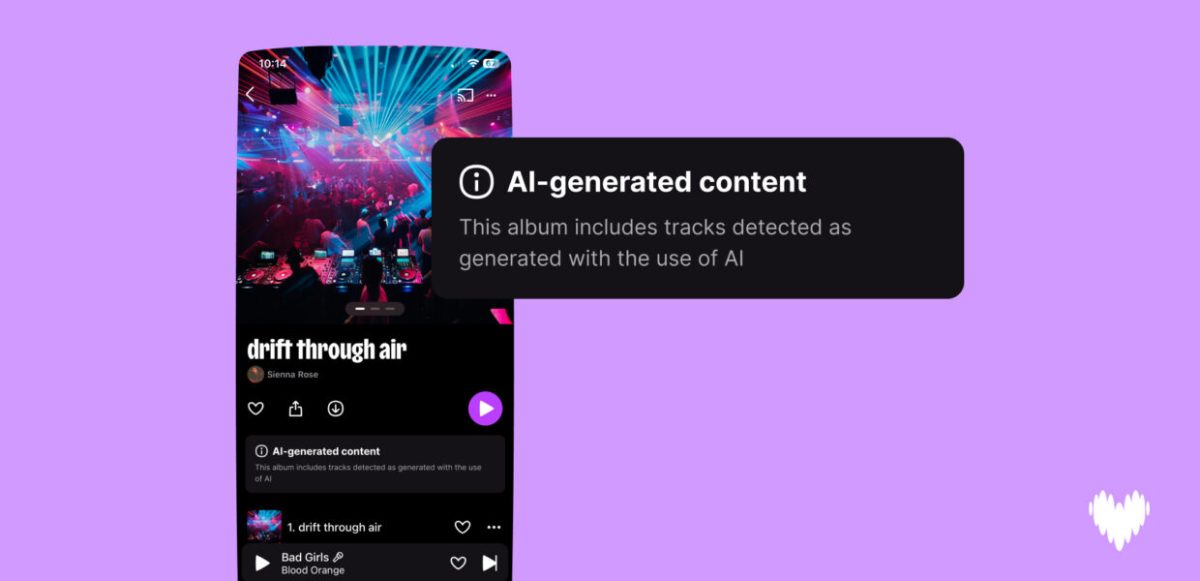
If the algorithm was already narrowing the listener’s world, what happened next made the problem structurally worse. The same platforms now processing tens of millions of legitimate tracks have, over the past two years, been inundated with AI-generated content at a scale that was not anticipated and is not yet fully under control.
According to data released by Deezer on July 21, 2026, fully AI-generated music accounted for more than half of all new tracks uploaded to its platform for the first time in June — with the platform receiving nearly 90,000 fully AI-generated tracks every single day. That figure marks an escalation from the 75,000 daily AI uploads Deezer reported in April, itself up from figures reported the previous year.
Deezer found that up to 85% of streams generated by fully AI-generated tracks were fraudulent in 2025, and that the primary purpose of uploading these tracks to streaming platforms is fraudulent — a mechanism by which bad actors generate artificial plays on bulk-uploaded generic content to siphon royalties from the shared payment pool.
Spotify’s response has been the most aggressive yet: the platform removed an estimated 75 million tracks in what amounts to one of the largest content purges in streaming history, targeting mass-produced AI content uploaded specifically to game the royalty system rather than AI-assisted music created as part of a legitimate artistic process. The distinction Spotify is drawing — between AI as a creative tool and AI as a fraud mechanism — is real and important. But 75 million removals also represents a significant compression of the catalog, and the detection systems making those calls are imperfect.
Deezer’s own proprietary AI detection tool, running since early 2025, detected and tagged more than 13.4 million AI tracks across that year — and the company has since applied for patents on the technology and begun licensing it to the wider music industry.
The Connection Nobody Is Making
Here is what the taste freeze research and the AI flood data have in common, and why they belong in the same conversation: both describe forces that are narrowing what music reaches adult listeners, and both are being amplified rather than counteracted by the current design of streaming platforms.
A listener in their mid-thirties, already neurologically predisposed to gravitating toward familiar music, is served by an algorithm that has been deliberately tuned toward familiarity and retention. That same catalog is being compressed by the removal of tens of millions of tracks — some fraudulent, some caught in detection systems that are not perfectly calibrated. And the discovery surfaces that might theoretically break the cycle — Discover Weekly, Radio, algorithmic playlists — are optimized for the very behavior they would need to disrupt in order to work.
The result is not a conspiracy. It is an emergent property of multiple systems, each individually rational, combining into something that is collectively limiting. The algorithm is doing what it was designed to do. The fraud cleanup is necessary. The taste freeze is biological. None of it was planned. All of it points in the same direction.
What Could Look Different
The MIDiA Research report that flagged the discovery fragmentation problem was not entirely pessimistic. Its conclusion was that music discovery is not dead — it is evolving, migrating to platforms like TikTok for younger listeners and remaining anchored in radio for older ones — and that the industry needs to evolve with it rather than assume the current model is working.
What that evolution might look like in practice is still being worked out. Some platforms have experimented with intentional friction — surfaces that deliberately surface unfamiliar music rather than optimizing for immediate engagement. Some artists and communities have built recommendation leagues and listening clubs specifically to escape the algorithmic bubble. Deezer’s CEO Alexis Lanternier, in his statement accompanying the 90,000-tracks-per-day revelation, called for the industry to align on shared standards — a call that is easier to make than to operationalize, but that at least names the problem correctly.
What Spotify’s Listening Age feature actually demonstrated — perhaps inadvertently — is that the data to understand this problem already exists inside the platforms. They know how old your taste sounds. They know what the algorithm is doing to your discovery habits. The question is whether that knowledge gets used to build systems that expand listening, or just to build better Wrapped cards.

Rudy (32) currently based in Bergamo, here since 2019.
https://www.linkedin.com/in/rudy-cassago-522452179/