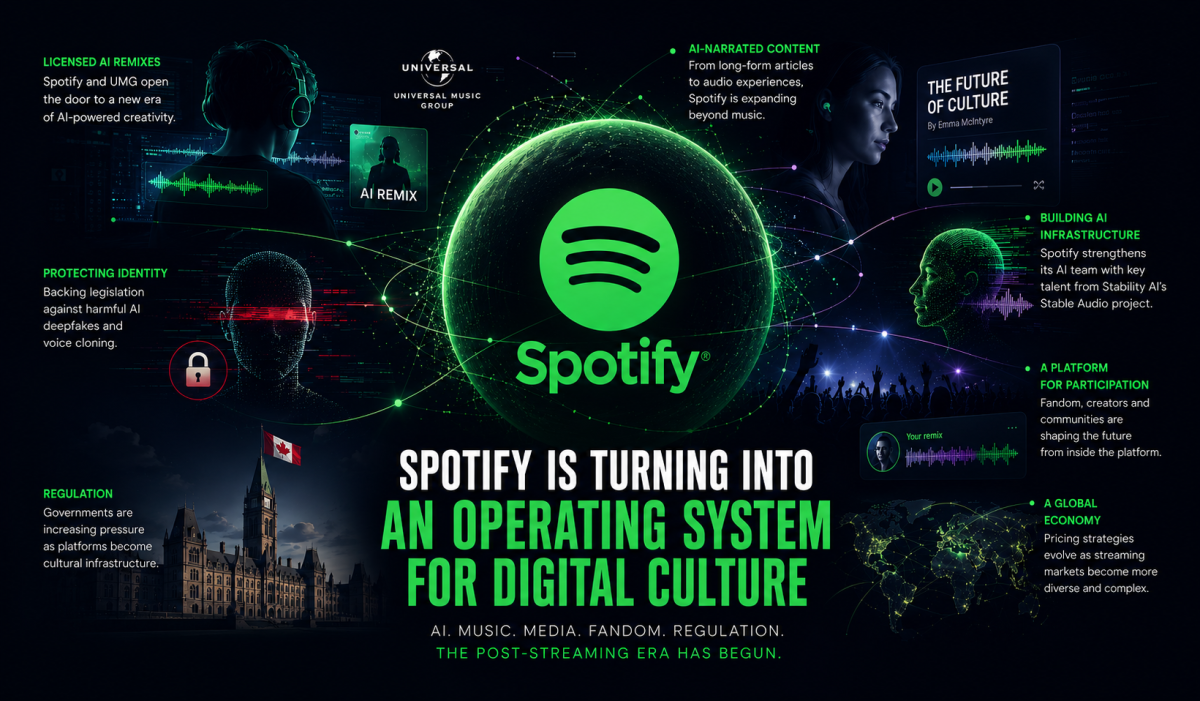
For years, Spotify’s role in the music industry felt relatively simple to define. It was a streaming platform built around instant access, endless catalogues, and frictionless listening. Music became available everywhere, at any time, often reduced to an invisible utility quietly running in the background of digital life. But Spotify’s latest moves suggest that definition no longer fully applies. Over the past few weeks, the company has announced a licensed AI remix partnership with Universal Music Group, backed legislation targeting harmful AI deepfakes, experimented with AI narration for long-form editorial content, reshaped pricing strategies across multiple emerging markets, and strengthened its internal AI division with the hiring of one of the researchers behind Stability AI’s Stable Audio project.
Individually, these developments may appear disconnected — a product update here, a policy decision there. Taken together, however, they reveal something much larger. Spotify is no longer evolving purely as a streaming service. It is gradually transforming into a broader ecosystem where music, media, AI, fandom, creator participation, commerce, and regulation increasingly intersect inside the same infrastructure. And that shift may ultimately say more about the future of digital culture than about streaming itself.
The Music Industry Is No Longer Fighting AI — It’s Trying to Control It
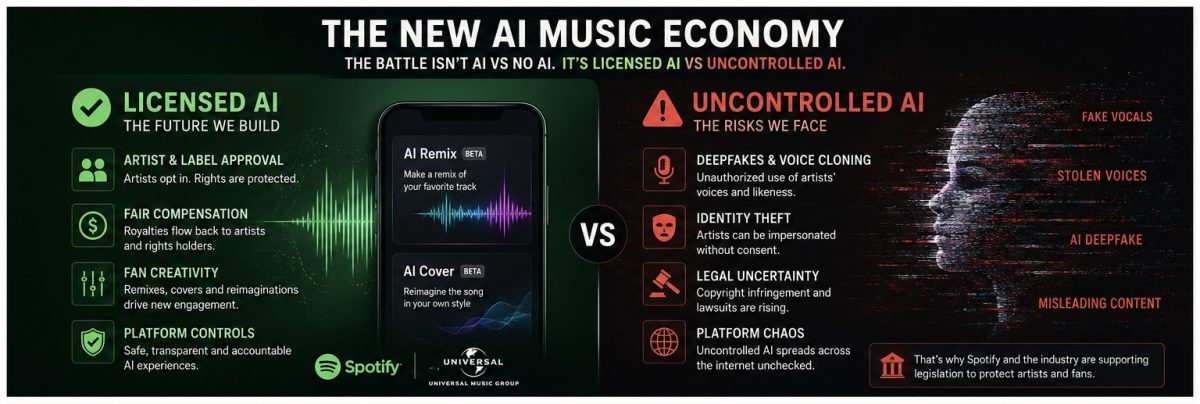
The clearest signal came from Spotify’s new agreement with Universal Music Group, which will allow Premium users to create licensed AI-generated remixes and covers using songs from participating artists. The importance of that deal goes far beyond the feature itself. For much of the last two years, generative AI was framed by the music business primarily as an existential threat tied to copyright infringement, unauthorized training data, and synthetic impersonation. But the industry’s posture is now beginning to evolve.
Spotify and the major labels are no longer rejecting AI outright. Instead, they are beginning to define which forms of AI-generated creativity are commercially acceptable, licensed, monetizable, and platform-approved. That distinction changes everything. The debate is no longer simply “AI versus no AI.” It is becoming a battle between licensed AI ecosystems and uncontrolled AI environments. And Spotify increasingly appears determined to own the layer where that licensed creativity happens.
From Passive Listening to Participatory Music
The UMG partnership also reveals something deeper about Spotify’s long-term ambitions. Streaming alone is no longer enough. For years, platforms competed primarily around access, recommendation systems, and listening convenience. The core interaction was fundamentally passive: users pressed play while algorithms optimized retention and discovery. Spotify now seems to be moving toward a more participatory model, where audiences are encouraged not only to consume music, but to interact with it, reinterpret it, and personalize it inside the platform itself. Music, in this context, becomes less fixed and more modular — something editable, remixable, and socially adaptable. That transition matters because it fundamentally changes the role of the platform. Spotify is no longer positioning itself solely as a destination for listening. It is increasingly positioning itself as an environment where cultural participation happens.
Control, Identity, and the Deepfake Problem
At almost the same time, Spotify joined a coalition supporting US legislation aimed at combating harmful AI deepfakes alongside companies including Google, OpenAI, Sony Music Entertainment, and Warner Music Group. On the surface, the move may appear contradictory. Spotify is enabling AI-generated remixes while simultaneously supporting regulation against synthetic voice cloning and impersonation. In reality, the two strategies are deeply connected. Spotify is not opposing AI. It is opposing unlicensed AI. That distinction may define the next phase of the music business. The companies most likely to benefit from generative AI may not be the ones attempting to eliminate it entirely, but those capable of building the dominant frameworks around how AI-generated creativity is licensed, monetized, distributed, and controlled. This is ultimately becoming a battle over identity, governance, and rights ownership as much as it is a battle over technology itself.
Spotify Is Expanding Beyond Music
The company’s recent experiments with AI-generated narration for long-form editorial content push this transformation even further. According to reporting from The Verge, Spotify has started testing AI narration for magazine-style articles, turning written editorial content into audio experiences directly inside the app. At first glance, this may seem like a relatively small product experiment. But strategically, it reveals something significant: Spotify increasingly wants to become more than a music platform. It is positioning itself as a broader audio-media ecosystem where music, podcasts, journalism, spoken-word content, AI narration, and personalised experiences coexist inside the same environment. That changes what Spotify is competing for. The company is no longer focused solely on owning listening time. Increasingly, it appears interested in owning ambient digital attention itself.
Building AI Infrastructure Internally
Spotify’s hiring of Julian Parker — one of the key researchers behind Stability AI’s Stable Audio project — reinforces the idea that this transformation is not temporary or experimental. It is infrastructural. Rather than relying exclusively on external partnerships, Spotify is actively building internal expertise around generative audio systems, synthetic media tools, recommendation technologies, and future creator workflows. That suggests AI is no longer being treated as a feature layer added onto streaming. It is becoming part of the platform’s core architecture. And importantly, this positions Spotify differently from traditional streaming services. The company is no longer simply distributing content. It is increasingly building systems through which content itself may eventually be generated, personalized, modified, narrated, and experienced.
Governments Are Starting to Treat Streaming Platforms Differently
At the same time, Spotify is facing growing pressure not only from artists and labels, but from governments themselves. Canada’s decision to significantly raise its streaming levy signals a broader global shift in how platforms are being perceived politically and economically. Streaming services are increasingly being treated less like disruptive technology companies and more like regulated cultural infrastructure. That distinction matters enormously. For years, streaming platforms benefited from the logic of scale and relative regulatory flexibility. But as their influence over cultural distribution has grown, governments are beginning to ask more difficult questions around taxation, accountability, and cultural responsibility. Music streaming increasingly appears to be entering the same regulatory phase already experienced by social media, digital advertising, and video platforms. And that transition could fundamentally reshape the economics of streaming itself.
The Global Streaming Economy Is Becoming Fragmented
Spotify’s recent pricing changes across markets including India, Indonesia, Saudi Arabia, the UAE, and South Africa reveal another important transformation. The global streaming business is no longer operating through a single universal model. In mature Western markets, Spotify increasingly focuses on higher-value monetization strategies tied to premium subscription layers, AI-powered features, and super-fan engagement. In emerging markets, however, affordability and large-scale adoption remain the central priorities. The result is a far more fragmented streaming landscape where platforms must adapt regionally rather than simply scale globally through identical strategies. Streaming has entered its maturity phase. And mature industries inevitably become more economically and structurally complex.
Spotify Is Becoming Infrastructure
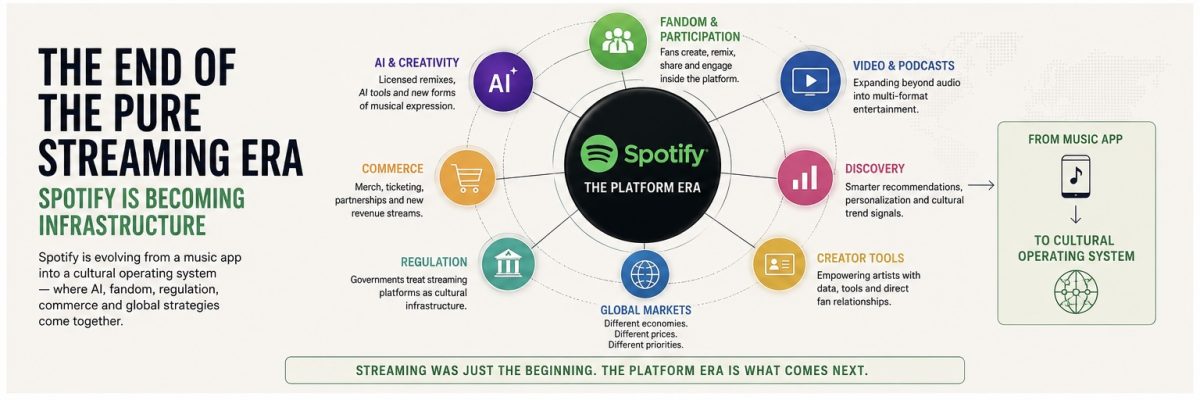
Taken together, these developments reveal something much larger than a collection of isolated announcements. Spotify is evolving into a hybrid ecosystem that increasingly blends music streaming, AI tools, creator participation, editorial media, commerce, personalization, fandom infrastructure, and platform governance into a single environment. This is no longer simply about music access. It is about controlling the layers surrounding digital culture itself — creation, discovery, interaction, identity, participation, and monetization. Because the streaming wars were primarily about scale. The next phase appears to be about ecosystems.
The Post-Streaming Era
For more than a decade, the music business revolved around one dominant narrative: streaming replacing ownership. But the industry now appears to be entering a much more complicated phase. AI is transforming creativity itself. Platforms are competing on participation rather than passive access. Governments are increasing regulatory pressure. And streaming companies are beginning to behave less like music services and more like operating systems for digital culture. Spotify’s recent moves do not simply reveal where the company is heading. They suggest that the pure streaming era may already be ending.

Rudy (32) currently based in Bergamo, here since 2019.
https://www.linkedin.com/in/rudy-cassago-522452179/