
A few years ago, Justin Bieber sold his music catalog for $200 million. Queen sold for over $1 billion. Sony Music Publishing just completed one of the largest single catalog acquisitions in history — the Recognition Music Group portfolio, formerly known as Hipgnosis, for a reported $3.5 to $4 billion, covering more than 45,000 songs. If your reaction to these numbers is “why is Wall Street buying music?”, you’re asking the right question. And the answer, once you understand it, reframes everything you thought you knew about how the music industry actually works.
This week, STVDIO+ published a comprehensive map of the music catalog ecosystem — how money flows from sovereign wealth funds and private equity giants down through major labels, independent music companies, boutique funds, and ultimately to artists. It is the clearest breakdown of the sector we’ve seen. Here’s what it shows, and why it matters right now.
Why Music Became an Asset Class
The origin story is simple: streaming. For the first time in the music industry’s history, royalties from recorded music and publishing rights generate consistent, predictable monthly cash flows. An artist like Queen or Bruce Springsteen now produces millions in royalties every month, reliably, year after year — the kind of steady income that large institutional investors call “yield”.
Private equity firms, pension funds, and sovereign wealth funds love yield. They manage billions in capital on behalf of retirees and governments, and they need investments that generate stable returns without excessive risk. Legacy music catalog — proven songs by proven artists, generating predictable streaming royalties — fits that profile almost perfectly. It behaves, in financial terms, like a long-duration bond: a stream of income spread across many years, with a value that can be calculated, rated, and securitized. As STVDIO+ puts it: music has become a new asset class. Wall Street provides the money. Music companies acquire and manage the catalog. Both share the returns.
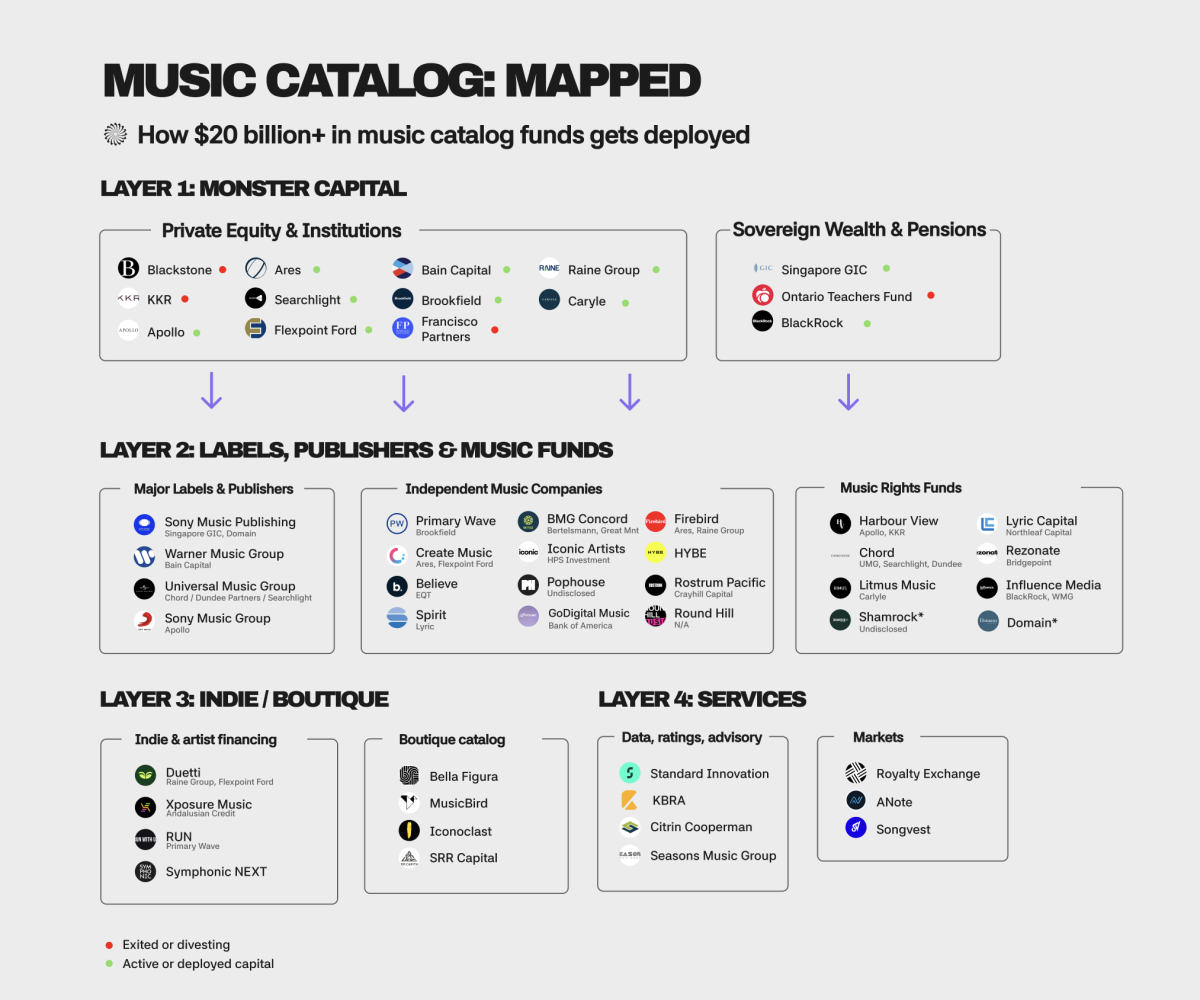
The Four Layers — How the Money Actually Moves
The ecosystem works in four distinct layers, each dependent on the one above it.
Layer 1: Monster Capital. At the top sit the largest financial institutions in the world — sovereign wealth funds, private equity firms, pension managers. They have capital but no music industry relationships. Apollo deployed $990 million into a joint venture with Sony Music and $1 billion into Harbour View. Singapore’s GIC committed $2-3 billion into a joint venture with Sony Music Publishing. Brookfield put $2 billion into Primary Wave. Blackstone deployed $1.58 billion to acquire Hipgnosis Songs Fund — the same portfolio that Sony Music Publishing just bought for $3.5-4 billion. These are not bets on the next big artist. They are infrastructure investments in proven income streams.
Layer 2: Large Catalog Buyers. The Monster Capital flows down to major labels, large independent companies, and dedicated music rights funds, which have the relationships and expertise to negotiate deals, manage rights, and extract value from catalogs. Sony Music Publishing acquired Queen (with UMG), Michael Jackson ($600 million for half of Mijac Music), Pink Floyd ($400 million), and now Recognition Music Group. Warner Music Group formed a $1.65 billion joint venture with Bain Capital and acquired a majority stake in Tempo Music. UMG holds a 25.8% stake in Chord Music Group. Primary Wave, backed by $2.225 billion — the largest dedicated music rights fund ever raised — acquired Kobalt from Francisco Partners in July 2026, adding AMRA, Kobalt’s digital collection society, to its portfolio.
The consolidation at this layer is accelerating. BMG and Concord confirmed their merger in April 2026, creating what will effectively function as a fourth major. As reported by Music Business Worldwide, this wave of consolidation is directly reshaping the financial infrastructure of the sector — with catalogs migrating from independent ABS vehicles into investment-grade platforms inside major companies.
Layer 3: Mid-Level and Indie Buyers. After the gold rush for megastar catalog cooled, a third layer emerged to acquire indie, niche, and boutique catalogs where the multiples are lower but the upside potentially higher. According to Chartlex’s 2026 tracker, multiplier ranges that peaked at 18-25x net publisher’s share in 2021 have stabilized at 12-18x in 2026 — a more disciplined market, but still active. Duetti, backed by $625 million, has signed over 1,100 independent artists. XPosure raised $50 million specifically for early-stage catalog. At the boutique end, UK firm Bella Figura manages Adele’s “Rolling in the Deep,” Robbie Williams’ “Angels,” and David Gray’s catalog from a £160 million base.
Layer 4: The Services Layer. A new ecosystem of data, ratings, advisory, and marketplace companies has emerged to support the catalog economy. Credit rating agency KBRA has become the closest thing the music ABS sector has to an independent monitor — having assigned 81 ratings across 18 issuers since 2020, totaling approximately $12.9 billion in music royalty-backed bonds. Marketplaces like Royalty Exchange, ANote, and Songvest now allow anyone to buy fractional shares in songs — bringing retail investors into a market that was previously institutional-only.
The Numbers Behind the Trend
The scale of activity over the past three years is striking when viewed in sequence. In 2024, global investments in music rights and acquisitions approached $5 billion according to Reprtoir, with Sony alone completing three blockbuster acquisitions — Michael Jackson, Queen, and Pink Floyd — in a single fiscal year. MBW’s tracker of the 21 biggest music deals of 2024 captured the scale: from Irving Azoff’s GRM to Daddy Yankee, the range of catalog types entering institutional ownership expanded significantly. UMG spent $288 million on catalog acquisitions in 2024 alone — up 49% year-on-year.
In 2025, MBW’s tracker of the 23 biggest deals showed a market that had matured rather than cooled: fewer individual artist megadeals, but larger structural transactions. The headline was Taylor Swift reacquiring her first six albums from Shamrock Capital in a $500 million all-cash deal — the most prominent example of an artist using the catalog economy to reclaim their own work rather than sell it. KBRA-rated music ABS issuance exceeded $3.3 billion for the second consecutive year. In 2026, Billboard’s tracker of the 13 biggest deals so far shows consolidation as the defining theme: Sony-Recognition ($3.5-4B), BMG-Concord merger, Primary Wave-Kobalt, Warner-Tempo Music. The market is not slowing — it is restructuring. Fewer independent entities, larger portfolios, deeper integration with major label infrastructure.
The Signal to Watch: ABS Issuance Is Falling — But Not Because the Market Is Cooling
The most counterintuitive data point in this picture is KBRA’s forecast for 2026: music ABS issuance is expected to fall approximately 25%, from over $3.3 billion annually to around $2.5 billion. At first glance, this looks like a slowdown. It isn’t. The reason for the decline, as KBRA’s May 2026 “Playback” report explicitly states, is “continued issuer consolidation” — catalogs that were previously backing independent ABS vehicles are migrating into major label balance sheets, where they no longer need to be securitized independently. When Sony absorbs the Recognition/Hipgnosis portfolio, $1.842 billion worth of Blackstone ABS transactions effectively exit the market — not because the value has disappeared, but because it has moved to an investment-grade platform that finances itself differently.
KBRA noted this may have “mixed implications” for the ABS market — consolidation improves diversification and scale at the servicing level, while reducing the number of independent issuers. The sector now includes 18 unique issuers, up from nine in 2023, providing a broader foundation even as individual transaction volume falls.
A New Variable: AI Training Licenses
One development that was not part of the catalog conversation three years ago is now actively being priced into deals: AI training licensing revenue. As Chartlex noted in its 2026 tracker, several majors and publishers signed AI training licenses with model developers in 2024-2025, and buyers are now pricing in the option value of licensing a catalog for AI training separately from its streaming income. It is not yet a confirmed cashflow line in most deals — but it is a meaningful upside thesis at the margins of pricing.
The implications are significant. A catalog that generates streaming royalties and can also be licensed for AI training purposes is worth more than one that generates streaming royalties alone. This creates an incentive structure in which the value of owning large, deep catalogs — particularly those with distinctive vocal performances, iconic productions, or strong genre identity — increases as AI music generation becomes a larger commercial market. The major labels’ lawsuits against unlicensed AI training, and their simultaneous investments in licensed AI platforms, are not separate from the catalog economy. They are part of the same calculation.

What It Means for Artists
The catalog economy has created a genuine new option for artists who have spent decades building a body of work. For those at the top — Bieber, Queen, Springsteen, Taylor Swift — the sums involved are life-changing and the decision is primarily financial and legacy-related. For mid-level artists, Duetti and similar platforms now offer acquisition starting from as low as $2,000, with more than 1,100 independent artists already on board.
The more complicated question is what happens to music creation incentives when the dominant financial logic of the industry rewards the past rather than the future. As STVDIO+ acknowledged in its analysis, many observers have pointed out that legacy catalog consumption is crowding out new releases, partly because companies are incentivised to promote the vast catalogs they have recently acquired. Whether the new capital flowing into the sector eventually frees up investment for frontline releases and artist development — or simply entrenches the dominance of legacy music in streaming algorithms and editorial playlists — is still an open question. The infrastructure is now built. The money is flowing. The answer to that question will define the next decade of the music industry more than any individual deal.

Rudy (32) currently based in Bergamo, here since 2019.
https://www.linkedin.com/in/rudy-cassago-522452179/