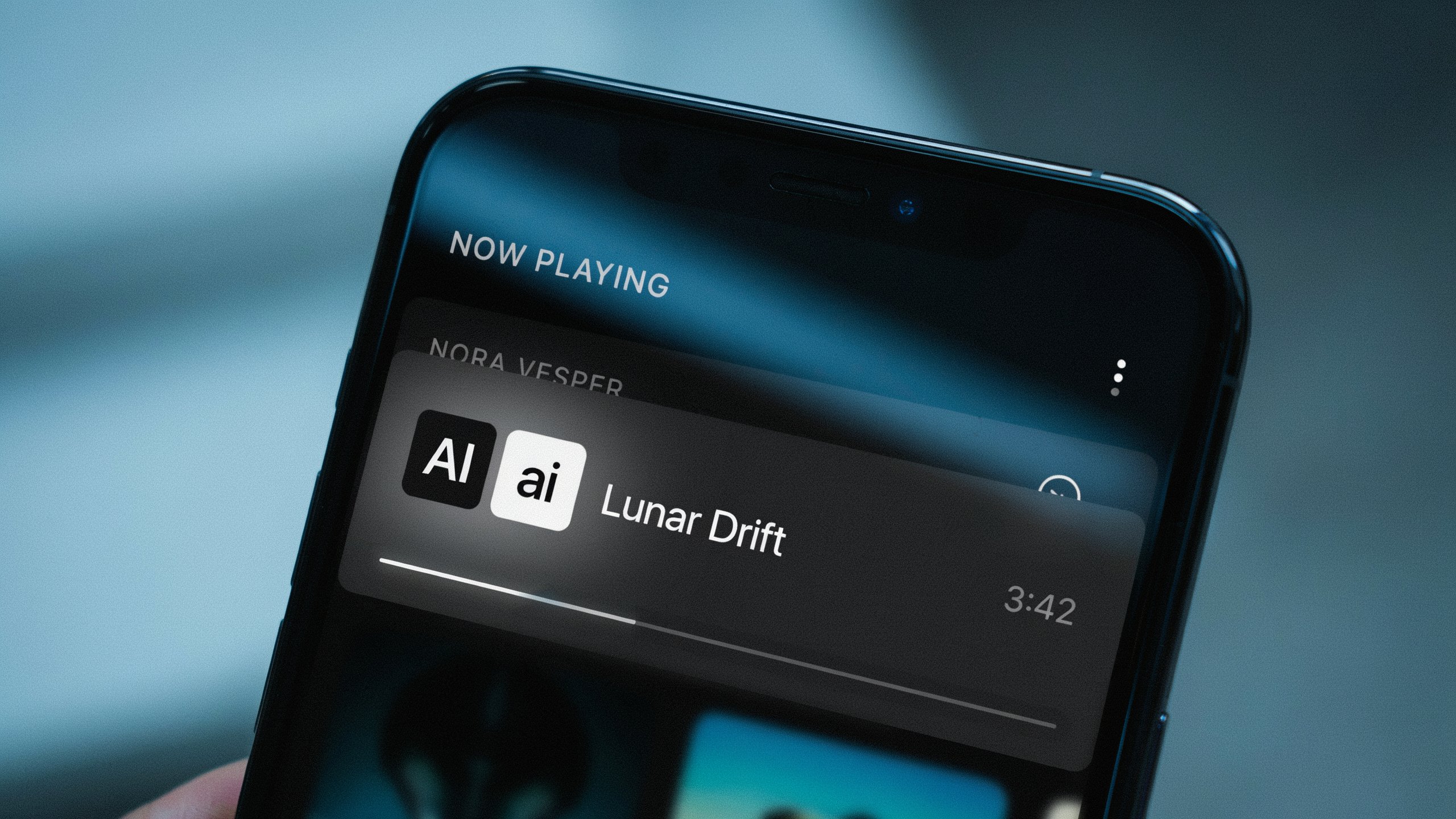
The Music Industry Just Proposed a Standard for Labeling AI Tracks. Now the Platforms Have to Decide.
On July 10, 2026, a coalition of major music industry bodies proposed what would amount to a universal labeling standard for AI-generated music on streaming platforms — a move that, if adopted, would make the AI origins of a track visible to every listener alongside the track title. The initiative, first reported by the Wall Street Journal and covered by Music Ally, is led by the RIAA and the IFPI, with backing from A2IM, the Recording Academy (the Grammys), SAG-AFTRA, and the Human Artistry Campaign. The fact that it’s industry-led rather than legislatively mandated matters — it puts the pressure on platforms to adopt voluntarily, with no legal obligation to comply.
Two Tags, Two Levels of Disclosure
The proposed system involves two distinct labels, each visually differentiated. The first — a bold uppercase “AI” in white text on a black background — would apply to tracks that are wholly AI-generated, or where the lead vocals or key instrumental performances come from AI. The second — a lowercase “ai” in black text on a white background — would apply to tracks where AI has been used for specific elements of an otherwise human creative process.
The binary distinction matters because it maps onto a real divide in how AI is used in music production today. Fully generated tracks and AI-assisted ones are fundamentally different creative and commercial propositions, and collapsing them into a single label would distort both categories. The coalition has also made clear that the system needs to be backed up by more detailed and accurate AI metadata delivered with tracks — meaning the labeling initiative is only as reliable as the data infrastructure underneath it.
The Platforms Are Not Yet On Board
The most significant open question is whether the streaming platforms will actually implement the system. As of the initial report, no DSP has publicly confirmed adoption — and the DiMA CEO Graham Davies offered what Music Ally described as a cautious welcome, while making clear the metadata infrastructure needs to improve significantly before any labeling can function reliably. That caution is not unfounded. Several platforms have already moved independently on this issue, in different directions. Apple Music announced its in-house detection system and Transparency Tags in May 2026, making it the first major DSP to publicly label AI-assisted tracks for listeners. Spotify, meanwhile, has been running a beta disclosure system since April where artists self-report AI use across vocals, lyrics, and production — and has silently removed millions of AI tracks over the past year according to its 2025 trust report.
TIDAL has moved furthest of all. Beginning July 15, 2026, the platform will apply AI music labels to tracks identified as fully AI-generated, block content designed to manipulate recommendations or royalty payments, and — most significantly — stop paying royalties entirely on wholly AI-generated tracks. The divergence across platforms is itself the problem the RIAA/IFPI proposal is trying to solve: without a shared standard, the same track gets treated differently depending on where it’s streamed, which makes the system incoherent for listeners and unenforceable for rights holders.
The Fraud Context Is the Real Driver
The labeling debate doesn’t exist in a vacuum. It’s being driven partly by a streaming fraud problem that has escalated well beyond what platforms were prepared for. Sony Music Entertainment revealed in March that it had asked streaming platforms to take down more than 135,000 songs created by fraudsters using generative AI to impersonate its artists. In a February op-ed, IFPI CEO Victoria Oakley and RIAA CEO Mitch Glazier wrote that generative AI has “industrialized” streaming fraud.
The scale of that framing — “industrialized” — is deliberate. It positions the labeling proposal not as a creative rights issue but as an infrastructure integrity issue: without disclosure, the royalty system can’t function accurately, PROs can’t attribute correctly, and platforms can’t distinguish legitimate AI-assisted releases from large-scale synthetic content farms gaming the per-stream payout model. There’s also a listener behavior dimension worth noting. Academic research cited by Music Business Worldwide found that listeners engage less deeply with music when it’s labeled as AI-generated — even when the track is actually human-made. That finding suggests disclosure carries real commercial consequences, which may partly explain why some artists and distributors might resist mandatory labeling even if they support transparency in principle.
Where the Legislative Layer Sits
The industry proposal lands alongside — not instead of — a parallel legislative push. The AI Labeling Act of 2026 was introduced on June 25 by Senators Brian Schatz, John Curtis, and Mark Warner, and would require providers of generative AI systems to attach a visible disclosure to AI-generated content, along with a machine-readable record of the system used and the time it was created. Large platforms with at least 10 million monthly US users or more than $1.5 billion in annual revenue would be required to flag that content and would be barred from stripping out the disclosures.
The industry initiative and the legislative proposal are structurally complementary: one creates a voluntary standard the industry can move on immediately, the other would eventually make disclosure legally mandatory. Whether the voluntary route generates enough adoption before legislation forces the issue is the live question.
The Electronic Music World Had This Conversation First
There is a telling gap between when the music industry formally proposed an AI labeling standard and when the people actually making and releasing music started demanding one. The RIAA/IFPI proposal landed in July 2026. The electronic music sector had been having this conversation in public, on conference stages, for at least two years before that.
As far back as IMS Ibiza 2023, the summit dedicated what it described as possibly its most important panel of the year to AI and music — framed around understanding the technology before it became unmanageable. By 2024, the conversation had sharpened considerably. At IMS Ibiza 2024, Voice-Swap hosted a panel called “Beyond the Hype: AI and Music in 2024,” bringing together an AIMI CEO, a music barrister, an artist, and a MIDIA analyst to move past headlines and examine what was actually happening — and where things were headed. The same year, ADE Pro 2024 hosted discussions on streaming fraud and AI, with the “Music Fights Fraud” campaign — uniting major labels, streaming platforms, and distribution companies — flagging verification, metadata integrity, and AI regulation as critical priorities.
By 2025, the electronic music conference circuit had moved from identifying the problem to demanding solutions. At IMS Ibiza 2025, AFEM’s session on generative AI noted that 6 million music creators were already using generative AI to compose music or lyrics, according to the IMS Business Report 2025 — and made clear that unregulated use posed a danger to creativity itself. Deezer’s CMO appeared at IMS Ibiza 2026 to reveal the platform was receiving 75,000 AI-generated uploads every single day, and that Deezer — currently the only major streaming platform actively labeling tracks as AI-generated — had reduced AI content in its playlists from 80% to 3% through active curation. Crucially, listener data was already suggesting that audiences don’t necessarily object to AI music instinctively, but they do want to know. Meanwhile, ADE Pro 2025 dedicated a full panel to AI legal frameworks, ownership of AI-generated music, and how artists can protect intellectual property while ensuring fair compensation.
None of this is incidental context. It means that when the RIAA and IFPI unveiled their two-badge proposal in July 2026, the electronic music sector — through IMS, ADE Pro, AFEM, and the artists and label executives who populate those rooms — had already spent three years mapping the problem, stress-testing solutions, and pushing platforms toward disclosure. The proposal from the majors is welcome. It is also, by the standards of the conversation that preceded it, somewhat overdue. And the metadata problem that underlies all of it was flagged even earlier. Writing for Music Business Worldwide in November 2025, Deviate Digital founder Sammy Andrews put it plainly: metadata has always been the industry’s weak spot, and in the age of AI the cost of half-measures is far higher. Her warning — that labels, publishers, and distributors risk building new rules on catalogues already riddled with inconsistent credits and missing data — remains as relevant now as it was when she wrote it. A labeling system is only as reliable as the infrastructure beneath it. And that infrastructure, by the industry’s own admission, was never fully built.
A Label Is Not a Solution — It’s a Starting Point
The two-badge system is a cleaner, more legible proposal than most of what the industry has managed to agree on in the AI space so far. But it solves one specific problem — consumer transparency at the point of listening — without addressing the upstream questions that remain contentious: who is responsible for accurate disclosure, what happens when metadata is stripped or falsified, and whether the labeling system extends to AI-generated content that imitates specific artists without using their recordings.
The system also requires streaming platforms to adapt their own infrastructure and collectively adopt the proposed badges — a coordination problem that has proven harder than it sounds, given that each major DSP has already started building its own detection and disclosure tools independently. The proposal is a step toward standardization. Whether the platforms treat it as a foundation to build on, or a rival to their own systems, will determine whether it amounts to anything. Should AI labeling on streaming platforms be industry-led or legislatively mandated — and does the distinction matter to you as a listener or creator?

Rudy (32) currently based in Bergamo, here since 2019.
https://www.linkedin.com/in/rudy-cassago-522452179/